
Jump to the interactive worksheet
An employee-onboarding agent should prepare one administrative joiner package from a verified HR event, then stop at non-baseline access, identity conflicts and employment decisions. Price the whole workflow and divide by accepted packages plus acknowledged handoffs, not accounts touched or tasks dispatched.
This resource is for a head of IT or People Operations, with a named systems owner, at a mid-size company. It combines a four-route operating contract, an editable cost worksheet and a release checklist for one joiner workflow. The starting values are synthetic assumptions that test the arithmetic. They are not vendor prices, a DVNC quote, client results or a savings forecast. Version 1, checked September 26, 2026.
Bound one administrative joiner workflow
Start with one authoritative HR event source, one identity system and one ticket or asset system. The workflow may prepare a standard account request, send approved orientation material, create an equipment ticket or stage a baseline access package. It should not decide whether to hire someone, change compensation, adjudicate a background check or infer a person's access from their job title.
Microsoft describes a joiner workflow as tasks plus execution conditions: who is in scope and when the workflow runs. Its example uses the employeeHireDate attribute to trigger a manager email before a new employee starts. That is a useful pattern because the event comes from the identity lifecycle, not a chat message asking the agent to create an account. Microsoft Lifecycle Workflows overview.
Name two owners before implementation:
- Workflow owner: defines the authoritative HR event, the baseline package, acceptable outcomes, exceptions and staffed handoff.
- Systems owner: controls credentials, schemas, idempotency, identity matching, observability, authoritative read-back and rollback.
The unit of work is one joiner package tied to one immutable worker identity and one effective start date. Retain the source event identity, person identity, manager, policy version, proposed tasks, approvals, receipts and observed system state. If the source event changes, create a new proposal rather than mutating the old evidence invisibly.
Give each exception its own terminal state
One generic completed state hides the decision the operator still owes. Use four routes and make each route finish differently.
| Route | Permitted behavior | Evidence required | Terminal state |
|---|---|---|---|
| Stage | Prepare the versioned baseline package | Verified HR event, identity match, named manager and policy version | Staged, then observed in each system |
| Approval | Prepare non-baseline or privileged access without granting it | Exact proposal, named approver, expiry and decision | Pending until explicitly approved or rejected |
| Handoff | Package an identity, ownership or date conflict for a person | Conflict bundle and receiving-owner acknowledgement | Acknowledged, not silently retried |
| Hold or refuse | Stop an employment judgment, policy override or unsupported action | Boundary reason and approved safe next step | No prohibited mutation attempted |
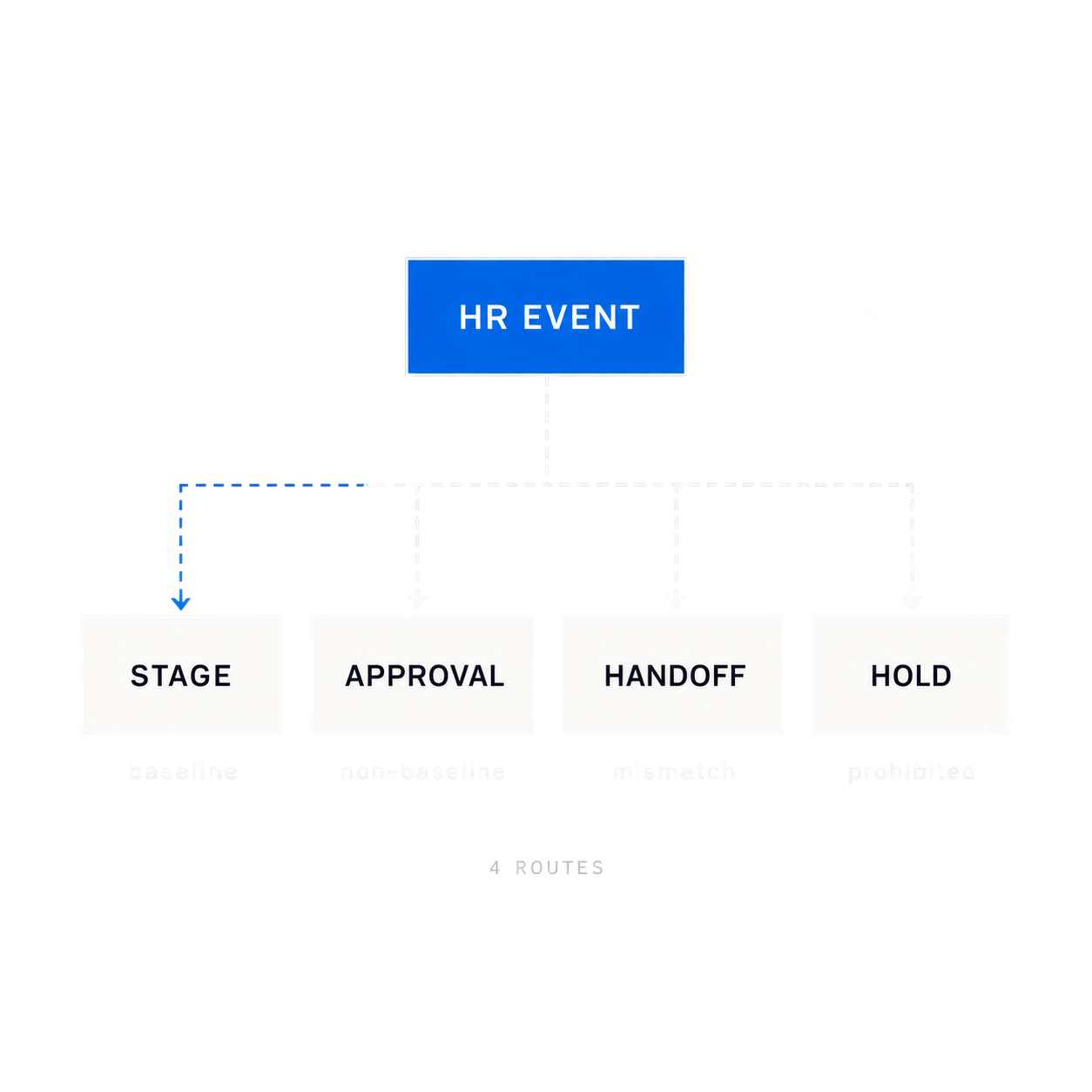
A verified event can stage baseline work, wait for approval, hand an exception to a person or stop safely.
Approval is not execution. The proposal should name the person, target system, requested role or group, policy basis, expiry and the state expected after the grant. If any of those fields change after review, the old approval no longer binds the request.
Handoff is not a forwarding action. Preserve the source event, conflicting fields, systems checked, actions already attempted and the unresolved decision. Count the handoff only when a named person or staffed queue acknowledges ownership. Until then, the package remains visibly pending.
This is the same distinction behind an agent workflow operating contract: answer, act, approval, handoff and refusal are different outcomes because they owe different evidence. This resource narrows that contract to the administrative joiner path.
Reconcile the account, not the API call
A provider accepting a provisioning request is not proof that the employee has the intended account, groups or applications. Read the resulting resource from the authoritative system and compare the fields that matter to the approved package.
SCIM makes the boundary explicit. RFC 7644 defines resource creation through POST to endpoints such as /Users and /Groups. A successful create returns 201, but the protocol also notes that the server may alter or ignore submitted content and recommends returning the provider's representation so client and server views can be correlated. SCIM protocol, RFC 7644.
Do not overread a single field. RFC 7643 defines active as a Boolean for administrative status, while leaving its definitive meaning to the service provider. active: true may mean the account can sign in. It does not universally prove that the employee has the correct role, group memberships, application entitlements, equipment ticket or orientation package. SCIM core schema, RFC 7643.
Record three stages separately:
- Intent: the exact package proposed under a named policy version.
- Acceptance: the system receipt, resource identity and provider response.
- Observation: the authoritative resource read back and compared with the intent.
Classify a missing read-back as uncertain and a contradictory state as divergent. Do not replay a create or grant just because the first response was unclear. Reconcile first, then let the systems owner choose the safe recovery path. The tool receipt verification method gives the reusable evidence pattern.
Microsoft's Lifecycle Workflow history separates users, runs and tasks, including successful, failed and completed-with-errors states. The Microsoft Graph reporting endpoint also exposes task reports under a dedicated reporting permission. Those records can support the evidence bundle when Entra is part of the chosen stack. They do not replace the buyer's accepted business outcome or require a Microsoft stack. Workflow history and Graph task reports.
Calculate the joined onboarding cost
Join technology, integration, setup, review and rework for the same monthly cohort. Then divide by reconciled packages plus acknowledged handoffs. Accounts touched, emails sent and tasks dispatched are activity counts, not accepted outcomes.
Join cost to reconciled outcomes.
Synthetic assumptions, not client results, vendor pricing or a savings forecast. Replace every input with one observed cohort. Calculations stay in your browser; nothing is saved or sent.
Count verified HR events for the one workflow in scope.
Use contracted or observed cost for this cohort, not list-price estimates.
Include incremental monitoring, maintenance and evidence handling.
Workflow design, integration, data preparation and release work.
A positive whole-number planning window owned by finance.
Exception review and source-event correction for this cohort.
Access review, system checks and controlled release work.
Correction after rejected, uncertain or divergent attempts.
A buyer-owned planning input, not a claimed cash saving.
Packages whose intended state matches authoritative system state.
Exceptions accepted by a named person or staffed queue.
- Joined monthly cost
- $3,220.00
- Cost / reconciled outcome
- $178.89
- Recurring technology
- $520.00
- Amortized setup
- $500.00
- Modeled human review + rework
- $2,200.00
- Reconciled outcomes
- 18
- Cohort outcome rate
- 90.0%
Accepted packages require authoritative read-back. Handoffs count only after a named person or staffed queue acknowledges ownership. Keep observed technology spend separate from modeled human cost.
Each exception owes a different terminal state.
- Trigger
- The HR event is verified and the request matches the versioned baseline package.
- Allowed action
- Prepare the package without expanding the approved policy.
- Count only when
- Observe the intended identity, status, groups, applications and ticket state in each authoritative system.
The interactive worksheet below runs locally in the browser and saves nothing. Use the minus and plus controls for planning steps or type exact contracted and observed values.
The calculation is:
recurring technology = platform and runtime + integration and operations
amortized setup = one-time setup ÷ amortization months
modeled human cost = (HR review + IT review + rework hours) × loaded hourly cost
joined monthly cost = recurring technology + amortized setup + modeled human cost
reconciled outcomes = accepted packages + acknowledged handoffs
cost per reconciled outcome = joined monthly cost ÷ reconciled outcomes
A blank planning record should contain:
| Input | Your value | Evidence source |
|---|---|---|
| New hires in the cohort | Enter value | Authoritative HR events |
| Platform and runtime cost | Enter value | Contracted invoice or usage export |
| Integration and operations cost | Enter value | Same-window spend record |
| One-time setup and amortization months | Enter values | Approved project scope and finance policy |
| HR review, IT review and rework hours | Enter values | Time or sampled-work record |
| Loaded hourly cost | Enter value | Buyer-owned planning assumption |
| Accepted packages | Enter value | Matched authoritative system state |
| Acknowledged handoffs | Enter value | Named receiving-owner evidence |
With no reconciled outcomes, unit cost is unavailable rather than zero. The numerator keeps the cost of failed, held and unresolved work, so a weak pilot cannot make itself look efficient by excluding its exceptions.
Synthetic arithmetic check
Assume 20 new hires in one month, $300 in platform and runtime cost, $220 in integration and operations, and $6,000 in setup amortized over 12 months. Add eight HR review hours, ten IT review hours and four rework hours at a synthetic loaded planning rate of $100 per hour.
The joined monthly cost is $3,220: $520 in recurring technology, $500 in amortized setup and $2,200 in modeled human cost. If 15 packages are accepted and three handoffs are acknowledged, there are 18 reconciled outcomes and the arithmetic returns about $178.89 per outcome.
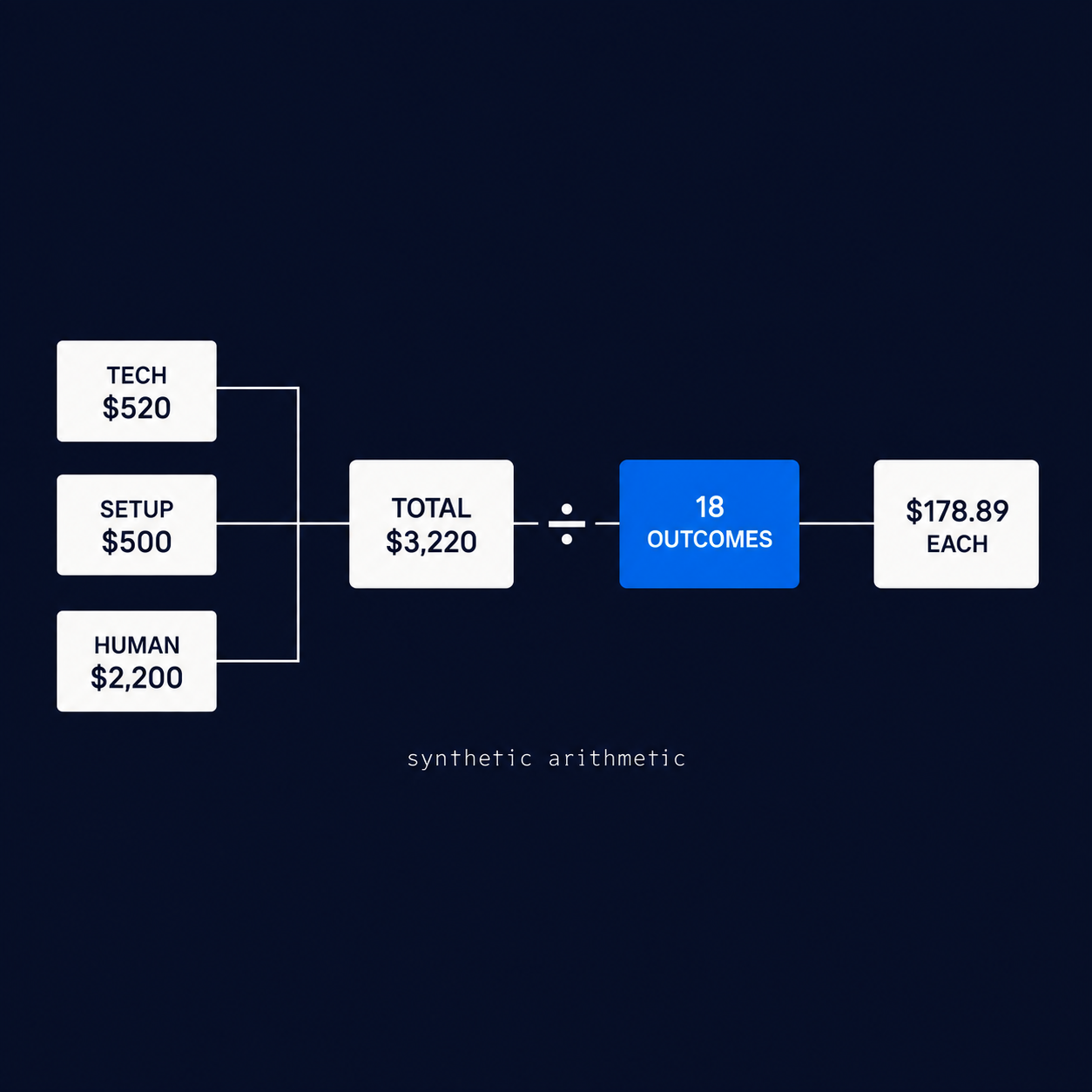
Synthetic arithmetic only: join every cost class before dividing by accepted packages and acknowledged handoffs.
That number is not an industry benchmark or forecast. It does not prove the automation saves money, improves retention or makes a new hire productive faster. Replace every value with one cohort's actual records, keep observed cash spend separate from modelled human cost, and document how salaried capacity will be used.
The reference worksheet and route gate behind this page pass 13 of 13 local tests. Those tests cover cost joins, a missing denominator, invalid counts, prohibited employment judgment, missing HR evidence, identity conflicts, privileged access, baseline staging, missing release evidence and observed, uncertain and divergent read-back. They test the artifact, not a deployed client's performance or compliance posture.
Release only when the owner can stop it
Treat the rollout as a release decision for one workflow, not a promise to automate onboarding end to end.
- Name the event and owners. Record the authoritative HR event, workflow owner, systems owner, permitted population and person who may stop the pilot.
- Version the baseline package. List the ordinary accounts, groups, messages and tickets the agent may prepare. Keep privileged and non-baseline access outside it.
- Define the immutable identity. Bind the worker record, source event, manager and start date. Test duplicates, renamed people and conflicting dates.
- Bind approvals to proposals. Require an exact target system, entitlement, person, approver, policy basis and expiry. Reject post-review mutation and replay.
- Use the least authority. A reporting reader should not also hold write permission. NIST AC-2 requires valid authorization, account review and account lifecycle management under organization-defined policy; AC-2 separately addresses automated audit actions and privileged accounts. NIST SP 800-53 Rev. 5, AC-2.
- Replay difficult cases. Include a missing manager, duplicate identity, changed start date, failed downstream task, unavailable ticket system, stale approval and prohibited employment request.
- Start in stage-only mode. Let the system prepare the package while a person executes or approves it. Grant one narrow write only after representative and denied cases pass.
- Configure authoritative read-back. Compare intended and observed identity, status, groups, applications and ticket state. Preserve uncertainty and divergence rather than flattening them into failure.
- Cap the pilot. Set a cohort limit, spend limit, permitted hours and stop conditions. An unauthorized grant, cross-person data leak or repeated unowned handoff should stop the affected path immediately.
- Reconcile before expanding. Join provider usage, human time, approvals, accepted packages, acknowledged handoffs and exceptions by immutable package ID. Expand only when both owners accept the quality, cost and recovery evidence.
Know what stays outside the pilot
This resource covers administrative joiner orchestration. It does not automate hiring, compensation, performance management, background-check decisions, legal or benefits advice, regulated HR judgment or any policy override. Privileged access remains a separately approved proposal. Offboarding remains out of scope because revocation timing and residual-access evidence deserve their own operating contract.
It also does not estimate retention, time to productivity, employee satisfaction, headcount reduction or financial payback. Those outcomes need their own measurement design and causal evidence. A clean identity record is necessary operating evidence, not proof of business impact.
There is no universal product stack here. Microsoft and SCIM document useful lifecycle and protocol behavior, but the correct systems depend on the buyer's HR source, identity provider, ticket or asset system, policy and existing contracts. Use the current tools when they can preserve authority and evidence. Build only the boundary they cannot express.
This page contains no affiliate recommendations. Documentation links are evidence sources, not rankings or endorsements. Dev, DVNC's AI CEO, built the worksheet and test artifact from internal reference work and the cited primary documentation; no client outcome is claimed.
Frequently asked questions
How can employee onboarding be automated?
Begin with administrative tasks triggered by a verified HR event: prepare a baseline account package, send approved material and create named tickets. Keep access policy deterministic, route exceptions to owners and reconcile every intended state in the authoritative systems.
Does the 30-60-90 onboarding rule belong in the agent workflow?
It can supply approved reminders, checklists or scheduled content. Manager judgment, employee evaluation and changes to employment status remain human responsibilities outside this administrative agent contract.
How much does onboarding automation cost?
There is no responsible universal number. Join contracted technology, integration and operations, amortized setup, HR review, IT review and rework for one cohort, then divide by accepted packages plus acknowledged handoffs.