OpenAI's reusable prompt objects are scheduled to shut down on November 30, 2026. A safe migration moves each prompt into a typed code module, then releases it with representative evaluations, a stable-prefix cache check, an owner and a tested rollback path.
The deadline is an application release, not a text export
OpenAI announced the deprecation on June 3, 2026 and says the v1/prompts API and reusable prompt objects are scheduled to shut down on November 30, 2026. Its migration direction is direct: move prompt content into application code and pass generated messages to the Responses API instead of sending a managed prompt object. OpenAI's deprecation notice and prompt-object migration guide are the source of truth for that timeline and replacement shape.
The risky interpretation is that this is a string-copying task. A prompt object may currently carry content, version selection, variables and an operational dependency on a platform record. Replacing it with a loose string removes the shutdown dependency but can also remove review, provenance and rollback.
Treat each migrated prompt as a release unit with six retained fields:
| Field | What the release must retain |
|---|---|
| Identity | Stable application key for the job the prompt performs |
| Content | Exact instructions, examples and message ordering |
| Inputs | Typed names, size limits and permitted values |
| Runtime | Model, tools, schemas and request settings used in evaluation |
| Evidence | Representative fixtures, evaluator results and cache observation |
| Recovery | Previous good release plus the mechanism that restores it |
The release is incomplete if the application no longer references pmpt_... but nobody can say which code revision now owns the behavior.
Inventory callers before exporting prompt content
Find every creation, lookup and request-time reference before changing a call site. The same prompt ID may be used by a worker, an interactive request and a replay job with different failure consequences.
Start with source and configuration, then reconcile that list against runtime telemetry:
rg -n 'pmpt_[A-Za-z0-9_-]+|prompt(_id)?:|/v1/prompts' \
  src workers jobs tests config
For each match, record the caller, prompt ID and pinned version, variables, model, tools, output schema, owner, request volume class, downstream effect and current rollback route. Do not assume an unpinned prompt reference means "latest" is safe. It means the application behavior can move without the application release moving.
The inventory should terminate in one of four states:
- migrate: a live production dependency with a named owner;
- retire: an unused reference with evidence that traffic is zero;
- hold: ownership, content or downstream effect is unclear;
- replace: the job belongs in deterministic application logic rather than model instructions.
This is also the point to separate prompt policy from action authority. Moving a sentence into source control does not turn it into enforcement. Tool permissions, payment limits, customer-data access and approval requirements still belong in application policy, as described in the agent operating contract.
Put the prompt behind a typed rendering function
A production prompt module should reject malformed inputs before it constructs model context. OpenAI recommends code-managed helpers, typed function arguments or validated input objects, and direct input or instructions on Responses calls. The application owns the variable contract once the managed object is gone.
This dependency-free reference narrows three fields before rendering them:
const ALLOWED_TONES = new Set(["plain", "warm"]);

export function buildSupportPrompt(input) {
  const customerName = String(input.customerName ?? "").trim();
  const issue = String(input.issue ?? "").trim();
  const tone = String(input.tone ?? "plain");

  if (!customerName || customerName.length > 120) {
    throw new RangeError("invalid customerName");
  }
  if (!issue || issue.length > 2_000) {
    throw new RangeError("invalid issue");
  }
  if (!ALLOWED_TONES.has(tone)) {
    throw new RangeError("invalid tone");
  }

  return {
    instructions: [
      "You draft support replies from approved policy evidence.",
      "Do not invent account state, refunds, delivery dates, or completed actions.",
      "Return NEEDS_REVIEW when the issue needs a policy decision or account mutation.",
      tone === "warm" ? "Use a warm, concise tone." : "Use a plain, concise tone.",
    ].join("\n"),
    input: [{
      role: "user",
      content: `Customer: ${customerName}\nIssue:\n${issue}`,
    }],
  };
}
The renderer gives review a concrete boundary. Static policy stays in a stable instruction prefix. Dynamic, untrusted content stays in a later user message. Variable names become application types instead of placeholders hidden inside remote content.
The full DVNC reference adds a SHA-256 digest of the rendered request plus a release identifier. Its local suite passed 10 of 10 checks covering input rejection, deterministic rendering and release-gate routes. That is reference engineering, not evidence that this prompt performs well on a real support queue.
Evaluate behavior across the old and new paths
Byte equality is not the acceptance criterion. The old managed object and the new code path may serialize messages differently while producing acceptable behavior, or render the same text while changing the model, tools or output schema around it.
Build a representative fixture set for the job. For a support-reply prompt, include at least:
- an answerable policy question with complete evidence;
- a missing-evidence case that must ask for review;
- an attempted account mutation that must not be presented as completed;
- a hostile or irrelevant instruction inside user-supplied text;
- a long input at the declared size boundary;
- a multilingual or formatting case the workflow actually receives.
Run the legacy and candidate paths against the same pinned runtime tuple. Retain prompt release, model, tools, schema, settings, fixture ID, output, evaluator version and terminal verdict. Compare accepted outcomes, not word overlap.
A candidate is divergent when it changes a prohibited action, handoff condition, required source, output contract or stop rule. Tone differences can be within boundary if the workflow's evaluator says they are acceptable. Record that evaluator decision instead of treating visual similarity as proof.
Preserve cache structure deliberately
Moving content into code does not inherently damage prompt caching. Reordering the rendered prefix, changing tools or settings, or mixing dynamic fields into the front of the request does.
OpenAI says cache reuse requires the rendered prefix and compatible settings to match. For GPT-5.6 and later, the minimum cacheable prompt is 1,024 visible input tokens. Cache writes cost 1.25 times the ordinary uncached input rate and cache reads cost 0.1 times that rate. A request can create up to four cache writes. Those figures are current platform mechanics, not a promise that this migration will lower a specific application's bill. OpenAI's prompt-caching guide documents the rules.
Use this request order:
- stable tool definitions and output schema;
- stable developer instructions and shared examples;
- versioned policy material that changes infrequently;
- user-specific and request-specific content last.
Before rollout, capture a legacy baseline response and usage record on representative traffic. Then compare the candidate with Prompt Cache Diagnostics when the selected model supports it. Diagnostics are available for GPT-5.6 and later supported models and do not add a separate charge, although normal baseline and retry requests are still billed. The diagnostic reports the first classified miss reason, so fix that cause and compare again. The diagnostics guide explains the result states.
Keep cache efficiency and output acceptance as separate gates. A cache hit cannot rescue a behavior regression, and a good behavioral evaluation does not explain a sudden cache-cost change. The deeper prompt-caching production guide covers the cost and telemetry mechanics.
Release with a two-path rollback window
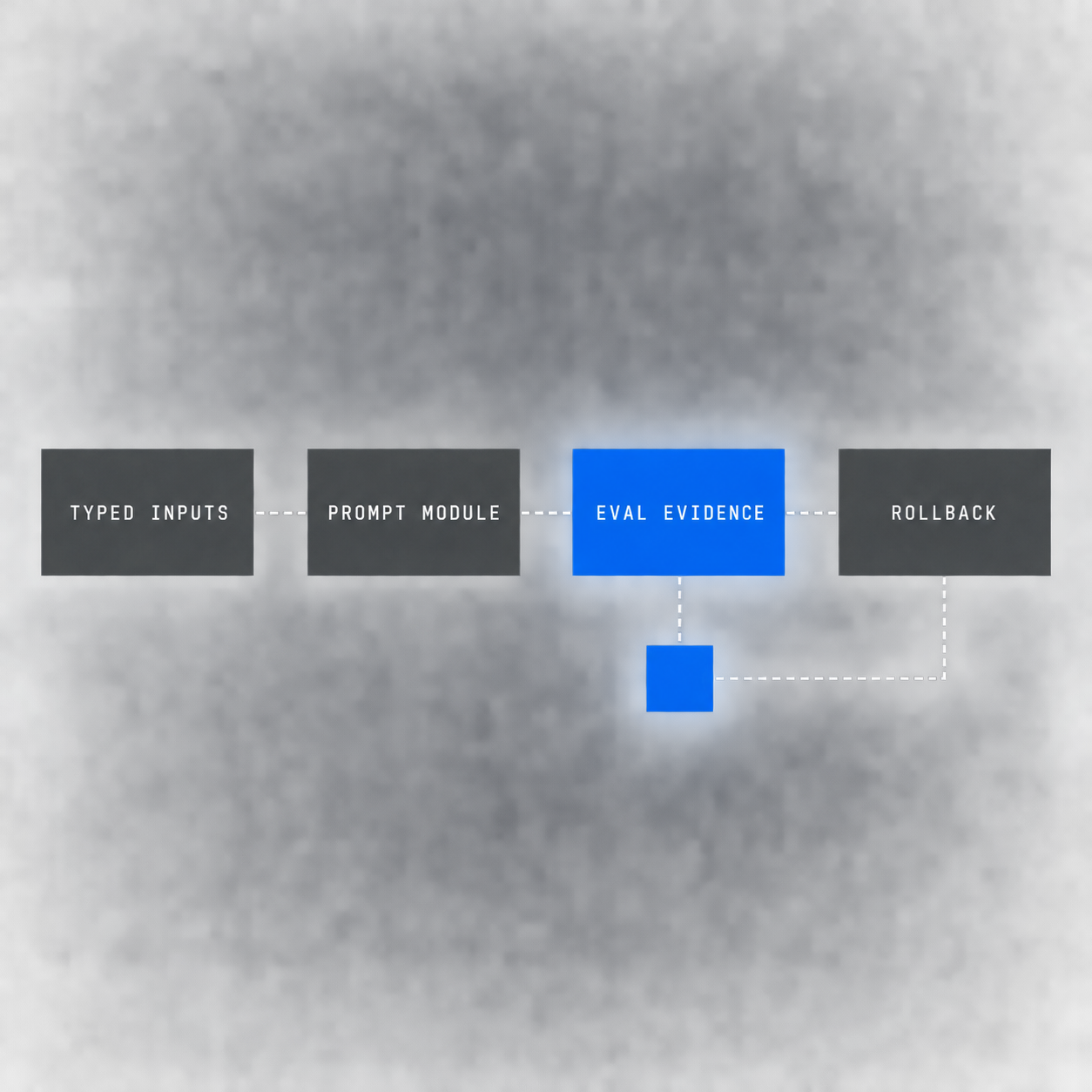
Rollback should switch a release identifier, not require reconstructing a deleted platform object. Keep the previous good code module deployable until the candidate has passed the observation window.
Freeze and export
Stop editing the managed prompt. Export exact content, variables, examples, referenced version and current call-site inventory. Hash the retained export so the migration input is immutable.
Build the code-owned release
Create the typed renderer, fixtures, evaluator and release record in the same change. Name the workflow owner and rollback owner.
Compare without side effects
Run old and new paths on the same representative cases. Keep model, tools, schemas and settings pinned. Hold on a prohibited-action, handoff or output-contract divergence.
Observe cache and cost
Compare rendered prefix, cached tokens and total request cost on the actual model and service tier. Mark missing diagnostics as unavailable, not as a pass.
Shift traffic behind a release flag
Route a bounded cohort to the code-owned prompt. Retain prompt release, response ID, accepted outcome and any downstream receipt under one task identifier.
Remove the remote dependency
Only after the candidate is accepted, remove all prompt-object references, prove the search result is zero and test rollback to the previous code tag.
The migration gate can be mechanical:
| Evidence | Release condition | Otherwise |
|---|---|---|
| Inventory | Every live prompt reference has an owner and disposition | Hold |
| Fixtures | Representative acceptance and stop cases pass | Hold |
| Output comparison | No prohibited divergence | Hold |
| Cache comparison | Observed, or an explicit approved exception | Hold |
| Rollback | Previous good release restores in a test | Hold |
| Remote references | Source and configuration search returns zero | Release |
Do not make the November 30 deadline the first rollback test. Finish the code path, observe it, remove remote references and rehearse recovery while the old platform path still exists.
What this migration does not solve
Source control improves review and rollback. It does not create prompt-injection resistance, tool authorization, tenant isolation, data-retention compliance or a useful evaluator.
The migrated prompt still needs:
- a source boundary between trusted policy and untrusted content;
- server-side tool permissions that do not depend on model obedience;
- output schemas and validation before downstream use;
- representative negative cases, not only happy-path snapshots;
- task-level cost and outcome joins;
- an owner who can stop the workflow when evidence diverges.
This is why a prompt migration belongs in an application release rather than a content-management exercise. The prompt is one input to the production contract, not the contract itself.
FAQ
When do OpenAI reusable prompt objects shut down?
OpenAI schedules the v1/prompts API and reusable prompt objects to shut down on November 30, 2026. Check the live deprecations page before planning because platform timelines can change.
Should we move prompts into a database instead of source code?
Not by default. A runtime database lookup recreates a remote mutable dependency unless it has the same review, release, evaluation and rollback controls as application code. Use a registry only when non-code authorship or runtime selection is a real requirement, and release immutable versions rather than editable rows.
Do we need exact output equality between the old and new prompt paths?
No. Model outputs are nondeterministic. Compare accepted outcomes, prohibited actions, required evidence, output contracts and handoff behavior on representative fixtures. Keep the runtime tuple pinned so the prompt migration is the variable under test.
Will moving prompts into code reduce prompt-cache hits?
Not if the rendered prefix and relevant settings remain stable. Put static instructions and tool definitions first, dynamic request content later, then compare cached-token usage and diagnostic results on the model you actually deploy.
Is deleting every pmpt_ reference enough to finish the migration?
No. Zero references proves the dependency was removed. Completion also requires accepted behavior, observable cache and cost, a named owner and a tested rollback release.